
3 min read
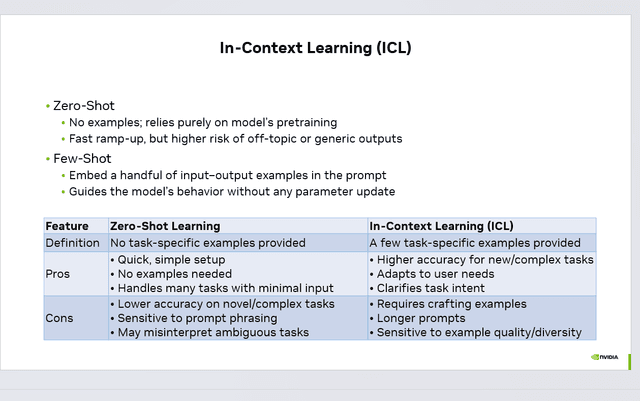
In-Context Learning (ICL): How Modern LLMs Learn Without Retraining
In-Context Learning (ICL): How Modern LLMs Learn Without Retraining
Deep dives into agentic AI, LLM evaluation, synthetic data generation, model selection, and production AI engineering best practices.
Showing 282 of 282 articles
In-Context Learning (ICL): How Modern LLMs Learn Without Retraining
How agentic AI systems monitor customer health scores, predict churn, automate outreach, and drive retention across global SaaS and enterprise organizations.
Workday's stock drops 22% as agentic AI threatens per-seat SaaS licensing. What the 'SaaSpocalypse' means for enterprise software buyers.
How agentic AI systems automate lab experiments, analyze research data, conduct literature reviews, and generate hypotheses to accelerate discovery in research labs worldwide.
KPMG projects agentic AI will drive $3 trillion in corporate productivity gains. With 44% of finance teams adopting AI agents in 2026, the shift from automation to autonomy is accelerating faster than anyone predicted.
How agentic AI systems manage data center cooling, power distribution, workload placement, and PUE optimization across global cloud infrastructure in the US, EU, Singapore, and Middle East.
Multi-agent code review systems assign specialized AI agents to analyze different aspects of pull requests in parallel. Here's why this approach catches bugs that single-agent tools miss entirely.
Lyzr AI raises funds at $250M valuation led by Accenture for enterprise agentic AI. Learn about the platform quintupling its valuation in months.
Microsoft 365 Copilot Wave 3 introduces Cowork with Claude-powered multi-step autonomous agents. See how long-running AI workflows change enterprise work.
How AI agents are transforming social media management through automated content scheduling, engagement analysis, ad optimization, and cross-platform strategy execution for global digital marketing teams.
Microsoft's M365 E7 license bundles Copilot and AI agents into one enterprise offering. How the unified AI bundle changes procurement decisions.
Corporate legal AI adoption jumps from 23% to 52% as multi-agent review systems ship. How agentic AI transforms legal document production.
How agentic AI systems coordinate disaster response, optimize resource allocation, manage communications, and maintain situational awareness during emergencies worldwide.
How agentic AI systems sense consumer demand signals in real time to adjust pricing, optimize inventory, and drive predictive commerce across global retail and CPG markets.
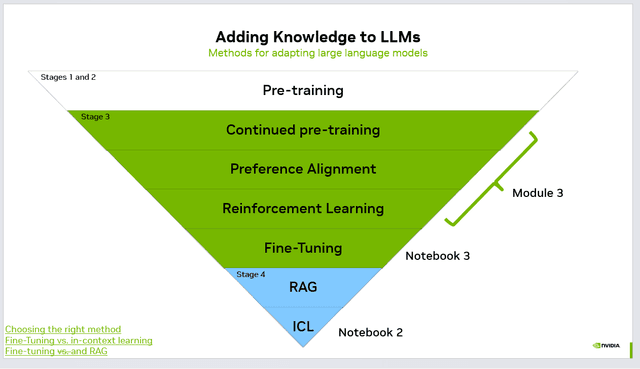
How Do LLMs Learn New Knowledge? 7 Techniques Every AI Engineer Should Know
How AI agents are reshaping portfolio management, financial planning, retirement optimization, and tax strategy across the US, EU, Singapore, and UAE wealth management markets.
Discover how AI agents streamline event logistics, vendor management, attendee engagement, and budget optimization across the global events industry.
How AI agents are powering smart city infrastructure across Dubai, Singapore, Barcelona, Seoul, and US cities through traffic optimization, energy management, and intelligent public service delivery.
Explore how AI agents are transforming nonprofit fundraising through donor outreach automation, campaign optimization, grant writing assistance, and real-time engagement tracking across the US, UK, and EU.
How AI agents are being deployed in clinical decision support — from diagnostic assistance and treatment recommendations to medication interaction checking — with a focus on safety and regulatory requirements.
How financial services, healthcare, and government organizations are implementing audit trails, explainability, and compliance frameworks for AI agent deployments.
Explore how agentic AI is optimizing water treatment plants, predicting demand patterns, detecting leaks, and improving water quality management for utilities across the US, Europe, India, and the Middle East.
Anthropic's computer use capability lets Claude interact with desktop interfaces — clicking, typing, and navigating applications. Technical architecture, use cases, and safety implications.
Learn how agentic AI is advancing veterinary diagnostics, enabling real-time livestock health monitoring, and improving animal disease detection across the US, Europe, Australia, and India.
Discover how agentic AI is transforming mining exploration through intelligent geological analysis, optimized drilling operations, and predictive mineral deposit modeling across major mining regions worldwide.
Learn how agentic AI is reshaping the hospitality industry through personalized guest experiences, intelligent booking management, and automated concierge services across global hotel and tourism markets.
Explore how agentic AI is revolutionizing aerospace through autonomous satellite constellation management, intelligent mission planning, and real-time anomaly detection across global space programs.
Huawei launches hyper-human voice AI agents at MWC 2026 with AICC platform. See how carrier-grade voice interaction is evolving for enterprise CX.
ArmorCode doubles growth with $16M funding to secure AI agents, MCP servers, and shadow AI. 80% of Global 2000 demand agent visibility.
Explore the emerging standards and protocols for AI agent interoperability — from the Model Context Protocol (MCP) to agent communication languages and tool-use standardization.
Discover how agentic AI systems are predicting fashion trends, generating designs, and optimizing collections for global fashion brands in 2026.
A deep comparison of stateful and stateless AI agent architectures — covering memory persistence, conversation context, checkpoint strategies, and when to use each approach.
Explore how agentic AI is reshaping music production with autonomous composition, mixing, mastering, and soundtrack creation tools across the global music tech industry.
Cross-industry benchmark data on AI agent resolution rates, cost savings, and customer satisfaction. AIMultiple's comprehensive performance report.
Explore how agentic AI is creating believable NPCs with dynamic storylines and adaptive behavior, reshaping the global gaming industry in 2026.
Turing benchmarks 6 AI agent frameworks across 2000 test runs measuring latency, token efficiency, and task completion rates for production use.
Comparing Google's Agent-to-Agent (A2A) protocol with Anthropic's Model Context Protocol (MCP), explaining how each approach solves agent interoperability differently.
Learn how agentic AI systems automate ESG reporting, carbon footprint tracking, and sustainability compliance across global regulatory frameworks.
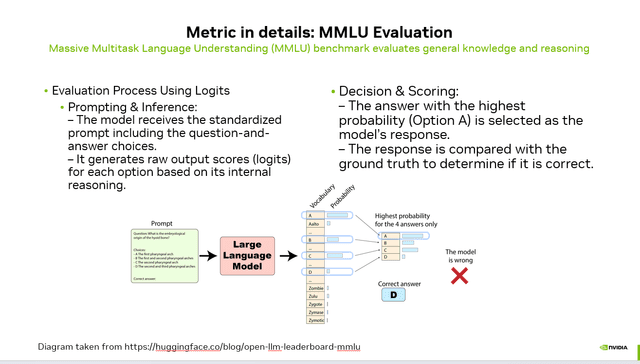
Massive Multitask Language Understanding (MMLU) benchmark evaluates general knowledge and reasoning
How AI agents are transforming legal document review — from contract clause extraction and risk flagging to due diligence automation — with accuracy benchmarks and deployment patterns.
YC-backed Trace raises $3M for workflow orchestration that maps complex corporate environments for AI agent context and adoption.
Deep dive into memory architectures for AI agents — short-term context, long-term vector stores, episodic memory, and procedural memory. Implementation patterns and real-world tradeoffs.
AI agents now complete whole college courses autonomously. What this means for enterprise training, workforce development, and L&D strategy.
48% of CISOs identify agentic AI as top attack vector. 88% report security incidents. Dark Reading's comprehensive threat analysis for 2026.
Andrew Ng-backed Profitmind raises $9M Series A for autonomous retail decision-making. Accenture Ventures leads the Agentic AI platform round.
Discover how agentic AI systems are transforming code review workflows by autonomously detecting bugs, suggesting fixes, and performing security scans across enterprise codebases.
How Claude enables real human-AI collaboration -- shared context with CLAUDE.md, intent-driven development, parallel workstreams, and team-level integration patterns.
Agno's AgentOS runtime delivers speed and composability for multi-agent Python systems. Compare it to LangChain and CrewAI for production agents.
Comprehensive evaluation of Retell AI, Vapi, PolyAI and more AI voice agent platforms. Features, pricing, and enterprise fit compared for 2026.
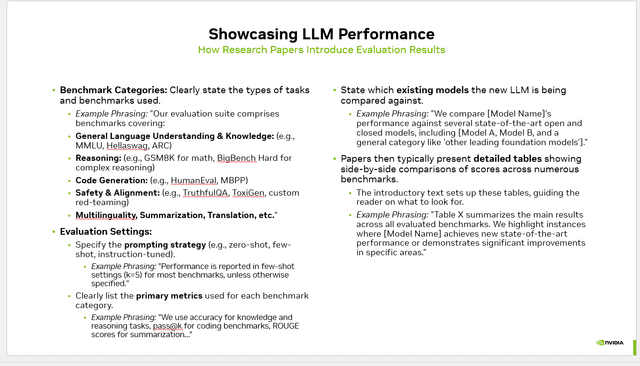
Showcasing LLM Performance: How Research Papers Present Evaluation Results
A layered testing strategy for AI agents -- unit tests with mocks, behavioral evals, LLM-as-judge semantic evaluation, integration tests, and production monitoring.
Salesforce Spring '26 launches 10 new agentic AI tools including Agentforce Builder with hybrid reasoning. Full feature breakdown and enterprise impact.
Explore how AI agents are transforming retail demand forecasting and inventory management, reducing waste and stockouts across US, EU, and Asia-Pacific retail operations.
Integrating the Anthropic Claude API in Go -- official SDK patterns, concurrent batch processing, streaming, retry logic, and production HTTP service architecture.
Discover how agentic AI is transforming sports analytics with autonomous athlete performance optimization, real-time game strategy, injury prevention, and scouting across US, European, and Asian sports leagues.
Major insurer cuts liability assessment by 23 days and improves routing accuracy by 30% with AI agents. How back-office automation scales.
Anthropic's Model Context Protocol (MCP) is emerging as the universal standard for connecting AI models to tools and data sources. How it works, who supports it, and why it matters.
Where agentic AI is heading in 2026 -- multi-agent coordination, persistent memory, AI-to-AI economies, developer leverage increases, and reliability engineering.
How AI agents are transforming DevOps practices by automating incident triage, root cause analysis, remediation, and infrastructure optimization in production environments.
Build a Claude-powered financial research agent using yfinance and news search that generates analyst-quality research notes on public companies.
How AI agents are transforming real estate operations — from intelligent property search and automated lead qualification to virtual showing scheduling and market analysis.
Discover how AI agents are managing and optimizing telecommunications networks and 5G infrastructure across the US, EU, India, China, and South Korea for improved performance and reliability.
Build a Claude-powered contract review system that surfaces risk clauses, extracts key terms, and generates structured attorney-ready reports.
Enterprise comparison of 7 top agentic AI platforms from Kore.ai to Simplai. Features, pricing, and use case fit for business decision-makers.
Mayer Brown's analysis reveals no unified legal framework governs agentic AI. How consumer protection, privacy, and contract law apply to AI agents.
Deloitte finds only 3% of healthcare orgs have deployed AI agents live despite 43% piloting. Learn what's blocking healthcare agentic AI adoption.
DeepL Voice API enables real-time speech transcription and translation into 5 languages simultaneously for multilingual AI agent deployments.
Explore how agentic AI is transforming pharmaceutical drug discovery through autonomous molecule screening, clinical trial optimization, and target identification across US, EU, China, and India markets.
How to build reliable AI agents using battle-tested distributed systems patterns: retry strategies, fallback chains, circuit breakers, and graceful degradation.
Production engineering guide for scaling Claude-powered AI agents -- request queuing, worker pools, rate limit management, cost control, and reliability patterns.
Learn how autonomous AI agents are transforming food safety inspection and quality control across the US, EU, China, and India, detecting contamination and ensuring regulatory compliance at scale.
Cisco's State of AI Security report reveals adversaries targeting MCP and agent-to-agent protocols. Learn the top agentic AI security threats in 2026.
A technical guide to building multi-tenant AI agent platforms with proper data isolation, per-tenant model configuration, usage metering, and security boundaries.
Stacks raises $23M for agentic finance automation covering AP/AR, reconciliation, and reporting. How AI agents transform enterprise finance operations.
Learn how agentic AI coordinates warehouse robots, automates inventory tracking, and optimizes order fulfillment across global logistics operations in the US, China, EU, and Japan.
Sedgwick's Sidekick Agent improves claims processing efficiency by 30%. How agentic AI transforms insurance from intake to settlement.
Agentic AI and AMRs are redefining warehouse operations in 2026. Learn how adaptive agent orchestration drives the smart warehouse revolution.
Build an automated PR review system with Claude that delivers actionable feedback within minutes, catching bugs and security issues before human review.
NIST launches AI agent standards initiative for identity, authorization, and interoperability. Federal framework details for enterprise compliance.
Data curation is the single biggest factor in LLM performance. Learn how NeMo Curator uses GPU-accelerated deduplication, synthetic data, and classification at scale.
Explore how agentic AI is revolutionizing predictive maintenance in oil and gas, monitoring equipment health, predicting failures, and optimizing maintenance schedules across global energy operations.
Technical guide to web-browsing AI agents with Claude -- tool-based vs Computer Use, Playwright integration, rate limiting, and common pitfalls to avoid.
Claude Computer Use enables AI to operate software visually -- architecture, real-world use cases, and production deployment considerations for enterprise automation.
Synthetic data generation has become essential for training high-quality LLMs. Learn the generate-critique-filter pipeline that transforms raw data into production-grade training sets.
Explore how agentic AI is revolutionizing the travel industry with autonomous itinerary planning, real-time booking optimization, and intelligent rebooking across flights, hotels, and activities.
Discover how autonomous AI agents are transforming bookkeeping, tax filing, audit preparation, and financial reporting across the US, UK, India, and EU accounting landscapes.
Legal framework for AI agent liability, data privacy, and sector-specific compliance. Venable's essential guidance for enterprise AI governance.
82% of HR leaders plan agentic AI by mid-2026. PwC outlines 5 critical actions for CHROs to transform recruiting, onboarding, and workforce planning.
AWS launches Bedrock AgentCore with Runtime, Gateway, Memory, Identity, and Policy services for building enterprise AI agents at scale.
Build a production-grade synthetic data pipeline for LLM fine-tuning and alignment with prompt critique loops, reward models, safety filtering, and practical examples.
Google Cloud case studies show AI agents delivering 3x-6x ROI within first year of deployment. Real enterprise results and implementation patterns.
How to build a reliable synthetic data pipeline for RAG and agentic AI systems using the generate-critique-filter-curate workflow trusted by production AI teams.
Discover how agentic AI is transforming banking fraud detection with real-time transaction monitoring, behavioral analysis, and autonomous account protection across global financial markets.
A step-by-step breakdown of the NeMo Curator data curation pipeline for LLM pre-training — covering web crawling, deduplication, quality filtering, and decontamination.
Telnyx ClawdTalk unifies telephony, compliance, and edge GPUs for low-latency voice AI agents. Full-stack carrier-grade platform breakdown.
NVIDIA survey reveals financial firms achieve 2.3x ROI within 13 months from AI agents. 44% of finance teams adopting agentic AI solutions.
Real-time dashboards, continuous monitoring, and intervention mechanisms for governing autonomous AI agents at enterprise scale in 2026.
Why the industry is moving beyond prompt engineering toward agent engineering, where the focus shifts from crafting individual prompts to designing multi-step autonomous systems.
Master the three approaches to document-level deduplication — exact hashing, MinHash with LSH, and semantic embeddings — to improve LLM training data quality.
Explore how agentic AI is reshaping journalism with automated news generation, real-time fact-checking, data-driven reporting, and editorial assistance while raising critical questions about media integrity.
Microsoft and Health Management Academy research shows 80%+ healthcare execs expect agentic AI to deliver significant value in 2026. Key findings inside.
CrewAI survey of 500 C-level execs reveals 100% plan agentic AI expansion. 31% of workflows already automated, 33% more planned. Full data breakdown.
Modern multilingual AI agents go beyond translation to cultural fluency. From Spanglish handling to cultural norm adaptation for global CX.
Proven architectural patterns for orchestrating multiple AI agents in production: supervisor, pipeline, debate, and swarm patterns with implementation guidance and failure handling.
How to build AI agents that monitor, optimize, and manage databases autonomously. Covers query optimization, index recommendation, anomaly detection, automated migration generation, and safety guardrails for database operations.
How to use Claude as an architecture review partner for system design. Covers design document review, trade-off analysis, scalability assessment, and building AI-powered architecture decision records.
Cisco launches AI Defense with AI BOM, MCP catalog, multi-turn red teaming, and AI-aware SASE for governing agent workflows in enterprises.
Deploy specialized procurement, logistics, manufacturing, and finance AI agents instead of monolithic systems. Multi-agent architecture guide.
McKinsey shows how agentic AI turns property managers into product managers. New operating model for tenant experience and building operations.
A practical framework for testing AI agent systems including deterministic unit tests, integration tests with mock LLMs, and end-to-end evaluation with LLM-as-judge patterns.
Discover how agentic AI is transforming the construction industry with intelligent project scheduling, real-time safety monitoring, cost tracking, and resource allocation across global building projects.
Complete guide to getting reliable structured output from Claude. Covers JSON mode, tool-use-as-schema, Pydantic validation, streaming structured data, and error recovery patterns for production applications.
Microsoft's vision for agentic commerce transforms how consumers discover and buy products. AI agents become the new retail storefront in 2026.
A practical guide to selecting between Claude Opus, Sonnet, and Haiku for different AI tasks. Covers benchmarks, cost analysis, latency comparisons, and model routing strategies for production systems.
Organizations report 171% average ROI from AI agents, with US enterprises at 192%. Framework for measuring AI agent returns on investment in 2026.
A practical guide to debugging AI agents that misbehave in production. Covers incident classification, root cause analysis patterns, logging strategies, kill switches, and post-incident review processes for agentic AI systems.
Learn how governments worldwide are deploying agentic AI to automate permit processing, benefits administration, citizen inquiries, and document handling to deliver faster, more accessible public services.
Analysis of the SWE-bench benchmark for AI coding agents, what it reveals about the state of automated software engineering, and practical lessons for building production coding assistants from the top-performing systems.
Learn patterns for orchestrating Claude across multi-step workflows including sequential chains, parallel fan-out, conditional branching, and human-in-the-loop checkpoints. Includes production-ready Python examples.
A detailed technical comparison of leading AI agent frameworks: CrewAI, Microsoft AutoGen, and the Claude Agent SDK. Covers architecture, multi-agent patterns, tool integration, and when to use each framework.
Deep dive into Claude's extended thinking and the think tool for agentic workflows. Learn how explicit reasoning blocks improve multi-step decision making, tool use accuracy, and complex problem solving in production AI agents.
Learn how to build AI-powered systems that automatically detect, diagnose, and fix code issues. Covers CI/CD integration, automated test repair, dependency updates, and real-world self-healing architecture patterns.
Discover how agentic AI is revolutionizing e-commerce with hyper-personalized product recommendations, dynamic pricing, intelligent cart recovery, and conversion optimization strategies worldwide.
NVIDIA's 2026 healthcare AI survey reveals 47% of orgs using or assessing AI agents. See where autonomous agents rank among top AI workloads.
How to design, implement, and debug AI agent workflows using DAG-based orchestration for reliable multi-step task execution with branching and parallel processing.
How AI agents are enabling truly personalized tutoring at scale — adapting to individual learning styles, pacing instruction dynamically, and providing Socratic-method guidance.
NIST's NCCoE concept paper proposes OAuth 2.0 standards for AI agent identity and authorization. Technical framework for enterprise agent security.
Design patterns for integrating human oversight into AI agent workflows — from approval gates and confidence thresholds to progressive autonomy and escalation protocols.
Explore how agentic AI is transforming telehealth with automated symptom assessment, intelligent patient triage, specialist routing, and follow-up management across healthcare systems worldwide.
Learn how AI agents are revolutionizing fleet management through route optimization, predictive maintenance scheduling, and fuel efficiency across US, European, and Middle Eastern transportation networks.
Master the art of writing effective system prompts for Claude. Covers structural patterns, role definition, constraint specification, output formatting, common mistakes, and advanced techniques for production-grade prompts.
Microsoft Dynamics 365 adds agentic AI for end-to-end supply chain automation from procurement to fulfillment. See how enterprises cut cycle times.
Using Claude to modernize legacy codebases -- generating tests, recovering documentation, incremental language migration, and avoiding common failure modes.
Objective technical comparison of the Claude API and OpenAI API for building AI agents. Covers tool calling, streaming, pricing, context windows, agent frameworks, and real-world performance benchmarks.
How multi-modal AI agents process and reason across images, audio, video, and text simultaneously, with real-world applications in document processing, robotics, and customer service.
A comprehensive guide to how AI agents are transforming anti-money laundering monitoring, transaction surveillance, and regulatory compliance in banking across the US, EU, Singapore, and UAE.
Concrete guidance for engineers building AI systems -- bias detection, fairness testing, transparency requirements, and responsible deployment practices.
Reduce your Claude API costs by 60-90% with these eight production-tested strategies. Covers prompt caching, model tiering, token budgeting, batch processing, response caching, context compression, and more.
Production-grade Python patterns for the Claude API. Covers async patterns, connection management, structured outputs, dependency injection, testing with pytest, and deployment strategies for Python-based AI applications.
Complete guide to using Claude's vision capabilities for image analysis, document processing, and OCR at scale. Covers image formats, multi-image analysis, PDF processing, prompt engineering for vision tasks, and cost optimization.
Building AI automation workflows using n8n and Claude API -- practical patterns for business process automation without a full development team.
Terminal-Bench Hard, tau-Bench, and IFBench rankings for production AI agent deployments. Which LLMs perform best for agentic tasks in 2026.
Google's Project Mariner brings AI agent capabilities directly into Chrome as an extension. How it compares to OpenAI Operator and what it signals about the future of web interaction.
Programmable voice APIs enable sub-800ms AI agent response times with streaming ASR and TTS. Build human-like conversational AI infrastructure in 2026.
Comprehensive guide to handling every error type in the Claude API. Covers HTTP status codes, SDK exceptions, retry strategies, circuit breakers, graceful degradation, and production monitoring patterns.
Production-ready TypeScript patterns for the Claude API. Covers SDK setup, type safety, error handling, streaming, middleware patterns, testing strategies, and deployment best practices for TypeScript applications.
Learn how AI agents are automating content marketing strategy, keyword research, content optimization, and performance tracking for digital marketers worldwide.
Building real-time AI applications with Claude -- SSE streaming, WebSocket bidirectional chat, and production latency optimization.
Build an autonomous research agent that searches the web, reads documents, synthesizes findings, and produces structured reports. Covers architecture, tool integration, source verification, and iterative deepening strategies.
Understand Claude's extended thinking feature, how it improves reasoning quality for complex tasks, when it adds value vs. unnecessary cost, and implementation patterns for production applications.
Master the Claude Message Batches API for high-volume, cost-effective processing. Learn how to submit batch jobs, poll for results, handle errors, and save 50% on Claude API costs for non-real-time workloads.
Step-by-step guide to building an automated code review bot using the Claude API. Covers GitHub integration, diff analysis, security scanning, style enforcement, and delivering actionable feedback on pull requests.
Real productivity data from teams using Claude -- what actually improves, what does not, and how to maximize gains.
Learn how event-driven architectures using message queues and event buses enable scalable, decoupled AI agent orchestration for complex multi-agent production systems.
Cambridge University research demonstrates agentic AI frameworks for real-time HVAC optimization. See how office-in-the-loop control systems work.
Explore how autonomous AI agents are transforming software testing by going beyond simple test generation to perform exploratory testing, bug reproduction, and end-to-end test maintenance.
Discover how AI is transforming DevOps workflows from code review to deployment, including AI-driven CI/CD optimization, infrastructure management, and incident response.
Explore how AI agents optimize last-mile delivery routes, scheduling, and real-time adjustments across US, EU, India, and Southeast Asian logistics networks.
Complete guide to implementing streaming responses with the Claude API. Covers SSE implementation, token-by-token rendering, error handling during streams, and production patterns for real-time AI applications.
Mastercard launches Agent Suite enabling AI agents to execute payments securely via tokenization. See how Agent Pay works within enterprise perimeters.
Comprehensive guide to understanding and working within Claude API rate limits. Covers rate limit tiers, retry strategies, request queuing, load distribution, and scaling patterns for high-volume applications.
Combining Neo4j knowledge graphs with Claude to overcome hallucination and knowledge cutoff limitations -- architecture and enterprise use cases.
Master Claude's 200K token context window. Learn strategies for structuring long prompts, avoiding the 'lost in the middle' problem, optimizing for retrieval accuracy, and managing costs with large contexts.
Practical security guide for production LLM applications -- prompt injection, jailbreak techniques, and layered defenses that work in production.
Technical deep dive into Claude's prompt caching feature. Learn how it works, when to use it, implementation patterns for both Python and TypeScript, and real-world cost savings analysis.
A complete guide to building a production-grade AI documentation assistant using Retrieval-Augmented Generation, covering chunking strategies, embedding models, vector stores, and answer synthesis.
Explore Claude's computer use capability and its implications for enterprise automation. Learn how Claude can interact with GUIs, navigate applications, and automate workflows that previously required human operators.
Learn how to build and deploy an AI gateway that centralizes LLM access with unified authentication, rate limiting, cost tracking, and provider abstraction for enterprise teams.
Learn how to build fully autonomous AI agents using the Claude Agent SDK. Covers the agentic loop, tool configuration, permission management, session persistence, and production deployment patterns.
Learn how to design and implement multi-agent systems using the Claude API and Agent SDK. Covers architecture patterns, inter-agent communication, task delegation, and real-world production examples.
A step-by-step guide to building a production-grade LLM evaluation framework that measures accuracy, safety, and quality across model versions and prompt changes.
Discover how agentic AI is transforming insurance claims assessment, fraud detection, and risk underwriting across the US, UK, and European InsurTech markets in 2026.
How to implement end-to-end observability for AI agents using OpenTelemetry traces, LangSmith, and custom instrumentation to debug failures and optimize performance.
Explore the architecture, limitations, and practical patterns for running LLM inference and AI workloads on serverless platforms like AWS Lambda and Google Cloud Functions.
McKinsey research shows AI agents boost enterprise revenue 3-15%, cut marketing costs 37%, and improve sales ROI by 10-20%. Top 10 use cases ranked.
Practical architecture for multi-agent research with Claude -- orchestration, agent specialization, result synthesis, and production lessons.
Complete guide to implementing tool use (function calling) with the Claude API. Covers tool definitions, execution patterns, multi-turn conversations, and production best practices.
Deep dive into the orchestrator-subagent architecture pattern used in Claude Code and the Claude Agent SDK. Learn how task decomposition, delegation, and result synthesis work under the hood.
A practical guide to deploying reasoning and chain-of-thought models in production, covering when extended thinking adds value, cost-performance tradeoffs, and implementation patterns.
OpenAI launches Operator, an AI agent that autonomously browses the web to complete tasks. How it works, what it can do, and the implications for web automation.
Using Claude to generate accurate, useful code documentation that stays in sync with code changes via CI/CD integration.
How AI research agents are accelerating scientific discovery by autonomously surveying literature, identifying research gaps, and generating testable hypotheses.
How to use Claude Code to debug production issues — analyzing stack traces, tracing code paths, reproducing bugs, fixing root causes, and preventing regressions.
A comprehensive guide to understanding, forecasting, and optimizing the costs of running LLM-powered applications in production, with real pricing data and cost reduction strategies.
How to roll out Claude Code across a development team — shared CLAUDE.md, custom commands, permission policies, cost management, onboarding, and team-wide standards.
How agentic AI systems transform business intelligence by autonomously querying databases, generating visualizations, and delivering insights without manual intervention.
A deep technical guide to designing AI and LLM processing pipelines using DAG-based architectures for reliable, observable, and scalable agentic workflows.
Learn how AI tutoring agents adapt to individual student learning styles, pace, and knowledge gaps to deliver personalized education at scale across the US, India, Europe, and Asia-Pacific edtech markets.
Learn how engineering teams are integrating AI into their code review workflows to catch bugs earlier, reduce review cycle time, and measurably improve code quality in production.
Clarify the distinction between function calling and tool use in the context of large language models, covering terminology differences across providers, architectural patterns, implementation strategies, and guidance on when to use each approach for building AI applications.
IBM explores who owns decisions made by AI agents and how outcomes can be audited. Essential governance framework for autonomous AI systems.
Agentic AI combined with Unified Namespace (UNS) is transforming manufacturing. Learn how smart factories achieve autonomous operations in 2026.
How Claude Code's extended thinking mode works, when to use it, how it improves complex reasoning, and practical tips for architecture, debugging, and refactoring tasks.
A deep technical dive into Claude Code's core tools — how Read, Write, Edit, Bash, Glob, and Grep work, when each is used, and how they combine for agentic workflows.
See how autonomous AI agents are transforming precision farming through crop monitoring, smart irrigation, pest detection, and yield prediction across the US, Brazil, India, and EU agricultural markets.
How to practice TDD with Claude Code — writing failing tests first, implementing to pass, and refactoring with AI assistance for faster red-green-refactor cycles.
A deep technical guide to implementing tool use (function calling) in LLM applications, covering tool design principles, error handling, parallel execution, security, and advanced patterns for building reliable tool-using AI agents.
SAP Joule Studio GA in Q1 2026 lets anyone build custom agentic ERP workflows with low-code. How the agent builder transforms SAP operations.
ServiceNow and OpenAI partner to bring agentic AI to 80B annual workflows with GPT-5.2 speech-to-speech automation. Enterprise impact analysis.
How to safely run AI agents in production with proper sandboxing, permission models, and security boundaries to prevent prompt injection, data exfiltration, and unintended actions.
Architecture blueprint for building AI-first customer support with voice and chat agents. From triage to resolution in the agentic support stack.
IBM's Enterprise Advantage helps CIOs scale agentic AI from experimentation to production with Microsoft partnership. Learn the deployment framework.
Using Claude Code for Python development — FastAPI, Django, SQLAlchemy, pytest, type hints, async patterns, and production-grade Python with AI assistance.
How AI agents are transforming marketing operations — from autonomous content creation and SEO optimization to multi-channel campaign management and performance analysis.
Learn how agentic AI systems are managing power grids, balancing renewable energy sources, and predicting demand to accelerate the clean energy transition across the EU, US, India, and Australia.
A comprehensive technical guide to implementing memory systems for AI agents, covering working memory (context window management), long-term memory (vector stores and databases), episodic memory (experience replay), and the architecture patterns that make agents truly persistent.
A practical comparison of the three leading agentic AI frameworks — LangGraph, CrewAI, and AutoGen — with architecture patterns, code examples, and guidance on when to use each.
Maximize Claude Code's TypeScript capabilities — type inference, generic patterns, strict mode compliance, Zod schemas, React types, and CLAUDE.md configurations for TS projects.
5 agentic AI trends transforming contact centers in 2026 including AI-to-AI interactions and real-time agent assist. Cost reduction data inside.
A practical guide to building production multi-modal AI systems that process images, audio, and text in unified pipelines. Covers architecture patterns, model selection, preprocessing, and real-world deployment strategies for multi-modal applications.
How AI agents are replacing scripted chatbots with systems that resolve customer issues end-to-end by accessing internal tools, making decisions, and taking real actions.
Discover how agentic AI is reshaping recruitment by screening resumes, scheduling interviews, assessing candidates, and reducing hiring bias across the global HR tech market.
A detailed technical comparison of Claude (Anthropic), GPT-4o (OpenAI), and Gemini 2.0 (Google) for enterprise applications in 2026, covering benchmarks, pricing, API features, safety, context windows, and real-world performance across coding, analysis, and reasoning tasks.
Strategies for using Claude Code to refactor legacy code — from targeted function rewrites to large-scale migrations, with patterns for safe incremental modernization.
An in-depth technical explanation of Constitutional AI (CAI), the training methodology Anthropic uses to align Claude with human values. Covers RLHF limitations, the constitutional approach, self-critique training, and what it means for building safe AI systems.
Integrate Claude Code into CI/CD pipelines for automated PR reviews, code quality checks, changelog generation, and deployment validation using headless mode.
Gartner predicts 40% of enterprise apps will feature task-specific AI agents by 2026, up from 5% in 2025. How CIOs should prepare for the shift.
Agentic AI service desks resolve IT tickets autonomously, reducing cost per interaction by 50%. Learn how autonomous IT support works in 2026.
ElevenLabs developer survey reveals shift from scripted bots to fully conversational real-time voice AI agents. Key trends and adoption data.
Parloa raises $350M Series D at $3B valuation for AI voice agents. The German-founded startup opens SF and NYC offices amid agentic AI boom.
How Claude Code helps write secure code — input validation, authentication patterns, secret management, OWASP coverage, and security-focused CLAUDE.md configurations.
A technical deep-dive into Mixture of Experts architecture, explaining how MoE models like Mixtral, DeepSeek, and Grok achieve massive parameter counts with efficient inference. Covers routing mechanisms, training strategies, and practical implications for AI engineers.
Explore how agentic AI is transforming legal contract review by flagging risks, suggesting revisions, and automating negotiation workflows across the US, UK, and EU legal tech markets.
How to use Claude Code as a code reviewer — from quick diff reviews to deep security audits, with real examples of bugs Claude Code catches that humans miss.
NRF 2026 reveals 68% of retailers plan agentic AI deployment for hyper-personalization. Key retail AI trends and implementation strategies.
A data-driven look at how to measure AI code generation quality beyond simple benchmarks, covering pass rates, bug density, security analysis, maintainability metrics, and practical strategies for improving code generation in production workflows.
Explore how agentic AI agents are redefining smart manufacturing through autonomous predictive maintenance, AI-driven quality control, and intelligent production scheduling across global factories.
Deep dive into Claude Code's CLAUDE.md memory system — file hierarchy, what to include, team conventions, per-directory overrides, and how memory shapes every interaction.
Learn how to implement semantic caching for LLM applications to dramatically reduce API costs and latency. Covers embedding-based cache keys, TTL strategies, cache invalidation, and production deployment patterns with Redis and vector databases.
Experian warns agentic AI enables machine-to-machine fraud, deepfake candidates, and cyber break-ins. Top 5 fraud threats for 2026.
A comprehensive look at direct and indirect prompt injection attacks targeting AI agents, plus practical defense patterns including input sanitization, privilege separation, and canary tokens.
Learn how GraphRAG combines knowledge graphs with retrieval-augmented generation to handle multi-hop reasoning, relationship-based queries, and global summarization tasks that naive vector-based RAG cannot solve.
Autonomous fraud agents initiate workflows, freeze accounts, and escalate cases in real-time. How agentic AI revolutionizes financial crime prevention.
How to configure, build, and use MCP (Model Context Protocol) servers with Claude Code — connecting databases, APIs, GitHub, Slack, and custom tools to your AI workflow.
A hands-on guide to deploying AI agent systems on Kubernetes, covering pod design, autoscaling based on queue depth, GPU scheduling, secrets management, health checks, and production-ready Helm charts for LLM-powered services.
A comprehensive guide to deploying agentic AI for customer onboarding automation — covering KYC verification, document processing, personalized setup flows, and compliance across fintech, SaaS, and banking.
Google Cloud launches Gemini Enterprise for CX, unifying shopping and customer service with AI agents on a single intelligent interface.
Master Claude Code's terminal features — headless mode, piping, multi-session workflows, vim mode, background tasks, and CLI flags that power users rely on.
Practical cost optimization strategies for production AI agents — from prompt caching and model routing to token budgets and semantic caching that can cut LLM API costs by 50-80%.
Deep dive into Claude Code hooks — pre and post tool execution hooks that let you enforce linting, run tests automatically, validate changes, and build custom CI-like workflows.
Bosch deploys agentic AI at the edge to cut HVAC energy costs by 35% while improving occupant comfort. Technical breakdown of edge AI architecture.
A practical guide to implementing observability in LLM applications, covering distributed tracing for multi-step agents, structured logging, cost tracking, quality monitoring, and debugging production issues with tools like LangSmith, Langfuse, and custom solutions.
Learn how agentic AI is transforming cybersecurity operations with autonomous threat detection, investigation, and response — reducing dwell time from months to minutes across global security operations.
Every Claude Code slash command explained with usage examples — from /compact for context management to /review for code reviews and /init for project setup.
A comprehensive guide to getting reliable structured JSON output from LLMs, covering native structured output modes, Pydantic validation, retry strategies, and production patterns for building robust data extraction pipelines.
Meta acquires Manus for $2B to build full-service AI agents. Learn what this means for the agentic AI competitive landscape in 2026.
A practical decision framework for choosing between fine-tuning and prompt engineering for LLM applications in 2026, with cost analysis, performance benchmarks, and real-world case studies across different use cases.
Gartner predicts over 40% of agentic AI projects will be canceled by 2027 due to escalating costs and unclear value. How to avoid the pitfalls.
Breaking down Claude Code's record SWE-bench Verified score — what the benchmark tests, how Claude Code achieves it, and what it means for your day-to-day development.
AI tutors cut one-on-one tutoring costs by 90% and slash time-to-completion by 40%. How agentic AI transforms higher education in 2026.
A practical guide to red-teaming LLM applications in production, covering prompt injection defense, jailbreak detection, output filtering, safety evaluations, and building defense-in-depth architectures for AI systems.
A practical guide to using Claude Code across the full stack — frontend React/Next.js, backend APIs, databases, DevOps, and end-to-end feature implementation.
Discover how agentic AI is automating property valuations through autonomous analysis of market data, comparable sales, and neighborhood trends across US, UK, Dubai, and Singapore markets.
An in-depth comparison of Claude Code, GitHub Copilot, and Cursor across code generation, debugging, refactoring, cost, and real-world developer workflows.
A comprehensive technical guide to Anthropic's Model Context Protocol -- the open standard for connecting AI models to external tools, data sources, and services. Covers architecture, server implementation, and real-world integration patterns.
How autonomous AI agents are transforming financial analysis and algorithmic trading — from portfolio research to real-time risk assessment — and the guardrails required.
An in-depth technical comparison of the three leading vector databases -- Pinecone, Weaviate, and Qdrant -- covering performance benchmarks, architecture, pricing, query features, and real-world deployment considerations.
The definitive guide to Claude Code in 2026 — installation, configuration, agentic workflows, tool system, memory, MCP integration, and best practices for maximizing productivity.
SAS releases 13 expert predictions for banking AI in 2026. AI agents tackle compliance monitoring, fraud triage, and customer onboarding.
Explore how autonomous AI agents are transforming supply chains through intelligent demand forecasting, automated supplier selection, and real-time logistics optimization across global markets.
A detailed technical comparison of LangChain, LlamaIndex, and custom orchestration approaches for building LLM applications in 2026, covering architecture, performance, flexibility, and real-world tradeoffs.
Move past naive RAG implementations with advanced techniques including hybrid search, re-ranking, query decomposition, contextual compression, and agentic RAG patterns used in production systems.
Learn the proven architecture patterns for deploying AI agents in production, including supervisor-worker topologies, state management, error recovery, and scaling strategies used by top engineering teams in 2026.
Practical deployment patterns for AI agents in enterprise environments including approval workflows, observability, access control, and governance frameworks.
Learn how to design and build effective admin dashboards for monitoring, managing, and debugging AI agents in production — from key metrics to real-time observability.
Who wins the battle for the enterprise agentic operating system? Salesforce Agentforce vs ServiceNow AI agents compared for 2026.
Explore how agentic RAG goes beyond simple retrieve-and-generate by letting AI agents dynamically plan retrieval strategies, reformulate queries, and synthesize across sources.
A practical guide to evaluating AI agents beyond simple accuracy metrics, covering task completion rates, tool use efficiency, reasoning quality, and emerging benchmarks.
Explore how AI agents are revolutionizing supply chain management — from demand forecasting and inventory optimization to autonomous procurement and real-time logistics coordination.
A detailed technical comparison of the three leading AI agent frameworks in 2026 covering architecture, orchestration patterns, tool use, and production readiness.
Learn battle-tested error handling and graceful degradation patterns that keep AI agents reliable when LLM calls fail, tools break, or context windows overflow.
Understand the five levels of AI agent autonomy, from human-in-the-loop copilots to fully autonomous decision-making systems, and how to choose the right level for your use case.
JSONL is the standard data format for LLM fine-tuning. Learn why JSON Lines works best, how NeMo Curator processes raw data into JSONL, and best practices for training datasets.
NeMo Curator provides GPU-accelerated synthetic data generation pipelines for LLM training. Learn the Open QA, Writing, Math, and Coding pipelines with practical examples.
NeMo Curator's Domain Classifier and Quality Classifier use GPU-accelerated RAPIDS to split LLM training data into balanced, high-quality blends at terabyte scale.
Traditional data curation pipelines for LLM training face critical bottlenecks in synthetic data generation, quality filtering, and semantic deduplication across text, image, and video modalities.
NeMo Curator delivers 17x faster data processing with measurable accuracy gains. See the GPU scaling benchmarks and real-world performance improvements for LLM training.
Learn how quality filtering and fuzzy deduplication create a tradeoff in LLM data curation, and how NeMo Curator uses GPU acceleration to handle both at scale.
Azure AI Foundry Agent Service provides a managed framework for building, managing, and deploying AI agents on Azure. Compare it to Semantic Kernel, AutoGen, and Copilot Studio.
A comprehensive overview of AI agents — what they are, how they work, and the major platforms including GPT Agents, Gemini, Claude, Copilot, AutoGen, and AutoGPT.
NVIDIA's prompt-task-and-complexity-classifier categorizes prompts across 11 task types and 6 complexity dimensions using DeBERTa. Learn how it works and when to use it.
RAG strengthens LLM responses by grounding them in external knowledge sources. Learn how retrieval-augmented generation reduces hallucinations and enables real-time knowledge access.